Senning Repair, India
Senning Repair
India
-
Our Price USD 4320
-
Hospital Price USD 4800
-
You Save : USD 480
Booking Amount: USD 432. Pay Remaining 90% at the hospital.
Book NowAdditional Credit
Among the important extras we offer as part of the Additional Credit are the following:
-
Site Tourism For The Patient & Attendant
-
Airport Pick & Drop Service
-
Ambulance service at airport
-
Priority appointments with The Doctor
-
Cancel Easily Anytime with Full Refund
-
Room Upgradation
-
Free Online Doctor Consultation Valued at USD 20
-
Free hotel Stay for 5 to 7 days Accordingly
-
Welcome Kit at Arrival
-
Interpreter
-
Medical Visa Assistance
What is Included?
- Doctor consultation charges
- Lab tests and diagnostic charges
- Room charges inside hospital during the procedure
- Surgeon Fee
- Cost of implant
- Nursing charges
- Hospital surgery suite charges
- Anesthesia charges
- Routine medicines and routine consumables (bandages, dressings etc.)
- Food and Beverages inside hospital stay for patient and one attendant.
What is not Included?
- Extra Radiology Investigations
- Healthcare Professionals Charges of other consultations.
- Other Requested Services such as Laundry etc.
- Additional Pharmaceutical Products and Medicines After Discharge from Hospital.
- Management of Conditions Unrelated to Procedures or Pre-Existing.
- The cost of any additional implants will be in addition to the package cost.
Package Description
Senning Repair:
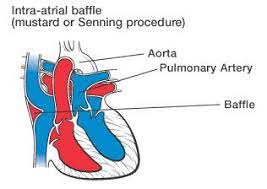
The surgeon creates the baffle using the patient's own tissue in a Senning technique. A synthetic substance is employed in the Mustard process. Because a baffle through the upper section of the heart, or atria, permits blood to reach the ventricles, these operations are referred to as "atrial switch procedures."
Disease Overview:
Transposition of the great arteries
The aorta and pulmonary arteries are transposed when the aorta emerges from the right ventricle and the pulmonary artery emerges from the left ventricle, resulting in independent, parallel pulmonary and systemic circulations; oxygenated blood can only enter the body through openings connecting the right and left sides (eg, patent foramen ovale, ventricular septal defect [VSD]). Severe newborn cyanosis and, if a VSD is present, cardiac failure are the most common symptoms. The existence of related congenital abnormalities affects the heart sounds and murmurs. Echocardiography is used to make the diagnosis. Surgical repair is the only way to go.
Signs and Symptoms:
Within hours of delivery, severe cyanosis develops, followed by metabolic acidosis due to insufficient tissue oxygenation. Patients with a moderate or large atrial septal defect, a large ventricular septal defect, a patent ductus arteriosus, or a combination of these defects have less severe cyanosis, but symptoms and signs of heart failure (e.g., tachypnea, dyspnea, tachycardia, diaphoresis, inability to gain weight) may appear in the first weeks of life.
Physical examination is normal except for widespread cyanosis. Unless there are concomitant irregularities, heart murmurs may be absent. S2 is the solitary and loud second heart sound.
Disease Causes:
During pregnancy, as the baby's heart is forming, transposition of the major arteries occurs. Most of the time, the cause is unknown.
It may be essential to understand how the heart normally pumps blood in order to comprehend transposition of the major arteries.
- The pulmonary artery, which delivers blood from the heart to the lungs, usually attaches to the lower right chamber of the heart (right ventricle).
- The lungs' oxygen-rich blood is next pushed to the heart's upper left chamber (left atrium).
- The blood then enters the bottom left chamber (left ventricle).
- The aorta, the body's major artery, usually connects to the left ventricle. It is responsible for transporting oxygen-rich blood from the heart to the rest of the body.
Disease Diagnosis:
ECG Echocardiography and chest x-ray
Clinical suspicion of transposition of the great arteries is confirmed by 2-dimensional echocardiography with colour flow and Doppler investigations, which is backed by chest x-ray and ECG.
The cardiac shadow on chest x-ray may resemble an egg on a string, with a thin upper mediastinum. Although the ECG reveals right ventricular hypertrophy, it is possible that it is typical for a newborn.
Cardiac catheterization is seldom required for diagnosis, however it may be used to widen the atrial communication (balloon atrial septostomy) or to better understand complicated coronary artery architecture.
Disease Treatment:
To cure the congenital cardiac abnormality, all newborns with full transposition of the great arteries (D-TGA) require surgery. Treatment for congenitally corrected transposition (L-TGA) is dependent on when the problem is discovered and whether or not there are any other cardiac issues present.
Before corrective surgery, the baby's doctor may prescribe drugs or a catheter treatment to assist control the issue.
Surgical or non-surgical techniques
Transposition of the great arteries surgery is generally performed within the first few days or weeks following birth. The type of transposition determines the options available. Patients with congenitally repaired transposition do not always require surgery.
The following surgeries and techniques may be used to treat transposition of the great arteries:
Atrial septostomy is a surgical procedure that removes the septum from the heart. As a temporary therapy, this catheter operation can be performed quickly. Balloon atrial septostomy is a surgery that expands a natural link between the heart's upper chambers (atria). It aids in the mixing of oxygen-rich and oxygen-depleted blood, resulting in increased oxygen delivery to the baby's body.
Operation of the arterial switch. This is the most common procedure for correcting great artery transposition. The pulmonary artery and the aorta are shifted to their proper locations during an arterial swap procedure. The pulmonary artery and the aorta are linked to the right and left ventricles, respectively. The aorta is also reconnected to the cardiac arteries.
Operation of the atrial switch The surgeon separates blood flow between the heart's two upper chambers during this procedure (atria). The right lower chamber (right ventricle) receives oxygen-rich blood returning to the heart from the lungs and pumps it to the aorta. The left lower chamber (left ventricle) receives oxygen-poor blood returning to the heart from the body.
The Rastelli method is used. If a newborn has a ventricular septal defect with transposition of the great arteries, this operation may be indicated. The surgeon uses a synthetic patch to seal the hole (septal defect) in the heart and redirects blood flow from the left ventricle to the aorta, allowing oxygen-rich blood to reach the body. The pulmonary artery's link to the left ventricle has been severed. The right ventricle is then joined to the artery that leads to the lungs through an artificial valve (pulmonary artery).
Procedure for a double switch. Congenitally corrected transposition is treated with this complicated surgical surgery.
It alters the major artery connections and redirects blood flow into the heart with the purpose of putting the left lower heart chamber (ventricle) in a position to pump oxygen-rich blood to the aorta.
Other cardiac disorders, such as ventricular septal defect or pulmonary outflow blockage, may necessitate further procedures. If the transposition of the major arteries disrupts cardiac signals, a pacemaker may be required (heart block).
Information related to Treatment
Package Details
Days in Hospital
7 Days
Days in Hotel
*
14 Days
Room Type
Private
Treating Doctor
Dr. Umesh Kohli
Interventional Cardiologist- Echocardiography, Pacemaker Implantation, Coronary Angiography, Coronary Angiogram, Cardiac Ablation, Cardiac Catheterisation, ASD VSD repair, Cardioversion, Implantable Cardioverter-Defibrillators (ICDS), Peripheral Angioplasty, Non Invasive Cardiology, Chest Pain Treatment, Bypass Surgery, CT angiogram, Cardiology, Balloon Mitral Valbuloplasty
Accord Super specialty Hospital Faridabad, India
24 Years of Experience
Treating Doctor
Dr. Sumit Narang
Cardiothoracic and Vascular Surgeon- Heart Failure Treatment, LVAD, Tricuspid, CABG on beating heart, Aortic Aneurysm Surgery, Double Valve Replacement, MVR, AVR, Peripheral & Carotid angioplasty and Stenting, TAVI/TAVR, PDA & ASD closures, VSD, Adult Valvuloplasty (mitral etc.)
Marengo Asia hospital, Faridabad Faridabad, India
26 Years of Experience
Treating Doctor
Dr Vineet Bhatia
Cardiologist- Pacemaker Implantation, Coronary Angiography, Coronary Angioplasty / Bypass Surgery, Cardiac Catheterisation, Pacemaker Implantation, Balloon Valvuloplasty, AICD Implantation, EPS, Optical Coherence Tomography, RFA, Pacemaker Implantation, Cardiac Catheterisation, Pacemaker Implantation, Pacemaker Implantation, Cardiac Catheterisation
Fortis Hospital Noida Noida, India
23 Years of Experience
Treating Doctor
Dr. Rajiv Parakh
Vascular surgeon- Carotid Surgery, Endovascular Interventions
Medanta-The Medicity, Gurgaon Gurgaon, India
35 Years of Experience
Treating Doctor
Dr Adarsh Koppula
Cardiac Surgeon- CABG on beating heart, CABG on beating heart, Valve replacement / repair, Blood Conversation in Cardiac Surgery
Max Super Speciality Hospital New Delhi, India
37 Years of Experience
Treating Doctor
Dr Rajnees Malhotra
Cardiac Surgeon- Left ventricular assist device (LVAD), Coronary artery bypass graft (CABG) surgery, Heart transplant, Heart Failure Treatment, Minimally invasive Cardiac Surgery, Heart transplant, Extra Corporeal Membrane Oxygenation-ECMO, Robotic Cardiac Surgery, Mitral Valve Replacement & Repairs, Atrial Septal Defects (ASDS), Aortic Valve Replacement & Repairs
Max Super Speciality Hospital New Delhi, India
31 Years of Experience
Treating Doctor
Dr Kumud Rai
Vascular surgeon- Aortic Aneurysm Surgery, Congenital Heart Disorder CHD, Correction of Varicose Veins, Aneurysmectomy and Peripheral Bypass Surgery
MAX Super Speciality hospital, Patpadganj Delhi New Delhi, India
29 Years of Experience
Treating Doctor
Dr. S. Radha Krishnan
Interventional Cardiologist- Pacemaker Implantation, Transcatheter Aortic Valve Implantation (TAVI), Coronary Angiography, Cardiac Ablation, Cardiac Catheterisation, Aortic Anuerysm Surgery/ Endovascular Repair, Cardioversion, Carotid Angioplasty And Stenting, Implantable Cardioverter-Defibrillators (ICDS), Pacemaker Implantation, Peripheral Angioplasty, PCI, TMT, TOF, PDA, DGTA, Pacemaker Implantation, Cardiac Catheterisation, Carotid Angioplasty And Stenting, Pacemaker Implantation, Peripheral Angioplasty, Cardiac Ablation, Cardioversion, Pacemaker Implantation, Cardiac Catheterisation
Fortis Escorts Heart Institute New Delhi, India
40 Years of Experience
Treating Doctor
Dr Roopa Salwan
Cardiologist- Echocardiography, Left ventricular assist device (LVAD), Coronary artery bypass graft (CABG) surgery, Pacemaker Implantation, Coronary Angiography, Bypass Heart Surgeon, Epilepsy Disorder, Cerebral Palsy Surgeon, Balloon Angioplasty, Mitral valve replacement, Cardiac Ablation, Congenital Heart Disorder CHD, Carotid Angioplasty And Stenting, Pacemaker Implantation, Hypertension Treatment, ICD implantation, Mycardial Infarction, Prevention of Blockage, Atherosclerosis & Heart At, Holistic Heart Wellness & Health Care - Ayurveda, Preventing Post Bypass Surgery Blockages, Preventing Restenosis, Stent Surgery, PTCA or Coronary Angioplasty, Myocarditis Treatment, Atrial fibrillation treatment, Mitral insufficiency treatment, Hypertrophic cardiomyopathy treatment, Ventricular tachycardia treatment, Cardiac catheterizations, Hip Disorders, Pacemaker Implantation, Echocardiography, Hypertension Treatment, Echocardiography, Carotid Angioplasty And Stenting, Pacemaker Implantation, Cardiac Ablation, Pacemaker Implantation
Max Super Speciality Hospital New Delhi, India
32 Years of Experience
Treating Doctor
Dr Kumud rai
Vascular surgeon- Aortic Aneurysm Surgery, Congenital Heart Disorder CHD, Correction of Varicose Veins, Aneurysmectomy and Peripheral Bypass Surgery
Max Super Speciality Hospital New Delhi, India
29 Years of Experience
Similar Packages